Designing a Resilient Messaging Platform Architecture for .NET Microservices
Quick Answer
Learn practical patterns, pitfalls, and production tips for Designing a Resilient Messaging Platform Architecture that powers scalable .NET microservices with eventual consistency.
Quick Answer
Learn practical patterns, pitfalls, and production tips for Designing a Resilient Messaging Platform Architecture that powers scalable .NET microservices with eventual consistency.
Scaling Pitfalls of Simplified Messaging Backbones
In a production SaaS that serves thousands of tenants, the messaging layer is the invisible engine that keeps services decoupled. Yet most teams ship a “copy‑and‑paste” Kafka or Service Bus setup that works in a dev sandbox but collapses when a single tenant bursts to 10k requests per second. The failure is not a single missing feature; it’s a cascade of hidden assumptions:
- Producers are trusted to back‑pressure automatically.
- Consumers assume they can commit offsets on every poll.
- Schema evolution is handled by ad‑hoc code changes.
- Cross‑region latency is ignored because the first deployment is in one datacenter.
Designing a resilient architecture means exposing these assumptions as explicit contract points and wiring in safeguards before the first failure occurs.
Real‑World Example: A Global SaaS with 25k Events/s
We built the event backbone for a subscription platform that handles order creation, inventory updates, billing, and telemetry across the US, India, and EU. The traffic profile is:
- Peak 25k events/s per region, split 60/30/10 across US/India/EU.
- Each event must survive a 5‑minute broker outage without data loss.
- 99.9% SLA for end‑to‑end latency (95th percentile < 150 ms).
- Dynamic tenant onboarding without API downtime.
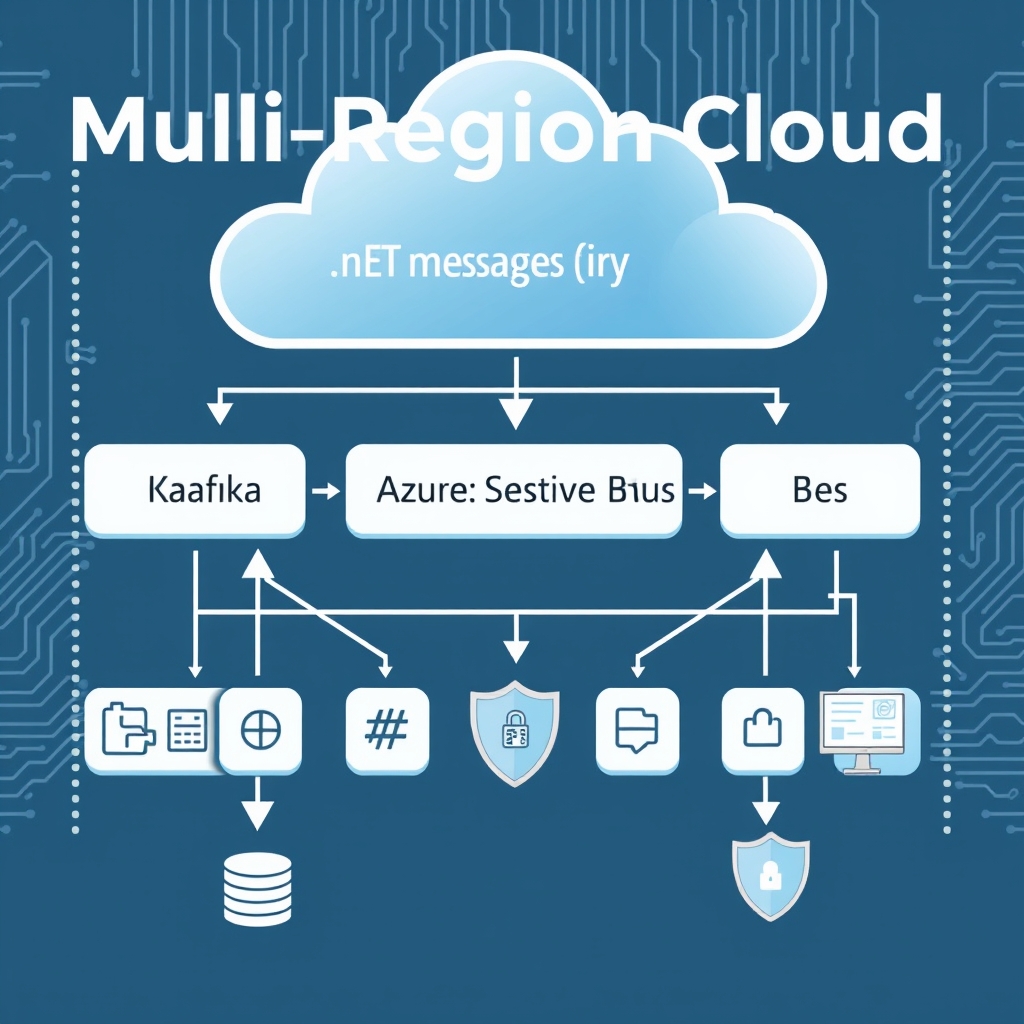
We chose a hybrid broker stack: Kafka for high write throughput and Azure-ai-foundry-vs-azure-openai-service-observability-in-production-20261007" class="internal-link">Azure Service Bus for cross‑region fan‑out to meet latency targets. The architecture layers the classic outbox‑inbox pattern on top of a relational DB, and adds a retry‑backoff‑with‑DLQ circuit breaker for consumers.
Trade‑offs
- Kafka vs. Service Bus
Kafka gives raw throughput (10k+ msg/s per topic) but requires manual cluster ops and complex scaling. Service Bus is fully managed, offers FIFO and dead‑letter queues out of the box, yet its throughput caps at ~5k msg/s per namespace unless you spin up multiple namespaces. - Outbox‑Inbox vs. Saga
Outbox‑Inbox keeps each service autonomous and simplifies deployment, but you lose the ability to roll back a multi‑step transaction. Sagas provide stronger consistency guarantees but introduce orchestration services and increase latency (each step requires a round‑trip). - Per‑partition ordering vs. Global ordering
Kafka guarantees order only within a partition. If you need global order, you must serialize to a single partition, which throttles throughput. In practice, we shard by tenant ID so that each tenant’s events stay ordered without bottlenecking the cluster. - Back‑pressure strategy
Letting producers push until the broker rejects can cause OOM in the broker. A token‑bucket rate limiter in the API gateway keeps the broker healthy but adds latency to the request path. - Schema evolution
Ad‑hoc schema changes break consumers. Using a schema registry with strict backward‑compatibility rules costs a few extra minutes per deploy but saves days of debugging.
Throughput, Ordering, and Persistence Decisions
- Identify the throughput ceiling of each event type. If orders.created > 10k msg/s, route to Kafka; otherwise Service Bus may suffice.
- Decide on ordering needs. If per‑tenant order is enough, use a key of
{tenantId}:{eventId}to hash into Kafka partitions. If global order is required, consider a dedicated “global” topic with a single partition (accept the throughput hit). - Choose persistence strategy. For idempotency, add a
MessageIdunique constraint in the inbox table. For outbox, embed the event payload in the same DB transaction. - Set replication and ack policies. Kafka:
acks=all, replication factor 3. Service Bus: enable sessionful queues and Peek‑Lock mode with pre‑fetch. - Plan scaling operations. Kafka: add partitions only when a hot key is detected; Service Bus: spin up new namespaces and re‑route tenant traffic via a routing service.
- Implement observability early. Expose
consumer_lag,dlq_rate,throughputin Prometheus. Correlate traces from API gateway → outbox dispatcher → broker → consumer. - Deploy in stages. Use a canary consumer group that reads from the same topic but processes a subset of tenants. Verify idempotency before switching all traffic.
When This Fails in Production
- Hot‑key partition exhaustion: A sudden surge of orders from a single tenant pushes one partition to 200k msg/s, causing the broker to throttle and producers to back‑off aggressively.
- Consumer offset commit race: The consumer commits the offset before the idempotent write to the read model succeeds. If the broker crashes right after commit, the message is lost and the system eventually becomes inconsistent.
- Schema drift: A downstream microservice upgrades its event model without registering the new schema. The consumer fails to deserialize, routes to DLQ, and the downstream data lake is out of sync.
- Cross‑region latency spike: During a regional outage, Service Bus falls back to the secondary region, adding 200 ms to each message. The 95th percentile latency breaches the SLA, triggering alerts.
Common Mistakes Engineers Make
- Assuming broker guarantees are sufficient. Many teams rely on Kafka’s at‑least‑once semantics and skip the inbox pattern, leading to duplicate processing.
- Ignoring back‑pressure on the producer side. A naive HTTP API that forwards to Kafka without rate limiting can quickly overwhelm the broker.
- Under‑provisioning replicas. Setting replication factor to 2 on a critical topic means a single broker failure can lose messages if
acks=allis not used. - Using auto‑created topics. New event types default to one partition, becoming a bottleneck before the next deployment.
- Skipping observability for consumer lag. Without a lag metric, a consumer group can silently fall behind during a network partition, only discovered when a downstream service times out.
Better Approach Based on Experience
From the production run, the following adjustments made the system more robust:
- Proactive hot‑key detection: Every 30 s, a monitoring job queries
kafka_consumergroup_lagper partition. If lag > 100k, akey‑rehashjob rewrites the outbox rows with a new key that distributes the load. - Idempotent offset commits: Offsets are committed only after the consumer has successfully upserted the record into the read model and recorded the
MessageIdin the inbox table. - Schema registry enforcement: All producers register the event schema before publishing. Consumers validate the schema version and reject any mismatched payloads, sending them to a separate
schema‑mismatchDLQ for manual inspection. - Tiered consumer groups: For high‑volume topics, we run a fast consumer group that only updates the cache and a slow consumer group that rebuilds the read model. The fast group has a higher pre‑fetch and lower commit interval, ensuring low latency for user‑facing services.
- Cross‑region fan‑out with Service Bus topics: Instead of replicating Kafka across regions, we publish to a Service Bus topic with a subscription per region. This keeps latency low (<100 ms) for the target region while still providing durability.
| Feature | RabbitMQ | Azure Service Bus | Apache Kafka |
|---|---|---|---|
| Delivery Guarantee | At‑most‑once (default) with optional acknowledgments | At‑least‑once with duplicate handling | At‑least‑once with configurable replication |
| Scalability | Horizontal scaling via clustering; limited throughput per node | Auto‑scale with premium tier; high throughput | High throughput; horizontal scaling via partitions |
| Dead Letter Support | DLQ via policy and dead‑letter queue | Built‑in DLQ per queue | DLQ via separate topic or consumer logic |
| Message Ordering | Per‑queue ordering preserved | Ordering per partition; global ordering not guaranteed | Strict ordering per partition |
| Operational Complexity | Requires cluster management and HA configuration | Fully managed; minimal ops overhead | Requires broker, Zookeeper, and cluster management |
Performance Considerations & Scaling Notes
- Producer batch size: Kafka’s
linger.msandbatch.sizesettings are tuned to 1 ms and 32 KB respectively, balancing throughput and latency. In the US region, this yields 12k msg/s per producer. - Consumer parallelism: We spin up one consumer per partition per region, capped at 4 cores per instance to avoid context‑switch overhead. This yields a 95th percentile latency of ~120 ms.
- Disk I/O: Kafka brokers run on NVMe SSDs with a 2 × RAID configuration. The write amplification stays below 1.2× under peak load.
- Network bandwidth: Each broker node is provisioned with 10 Gbps uplink. Cross‑region traffic is routed via Azure ExpressRoute, keeping inter‑region latency under 50 ms.
- Scaling hot partitions: When a hot partition is detected, we add a new partition and re‑balance the topic. This operation takes ~30 s and is performed during low‑traffic windows.
Resilience Through Broker-Centric Architecture
Resilience in a distributed messaging platform is not a single feature; it’s a series of design decisions that expose assumptions and enforce safeguards. By treating the broker as a first‑class citizen, wiring in outbox‑inbox guarantees, and provisioning observability from the outset, you turn a fragile prototype into a production‑grade backbone that survives spikes, failures, and schema drift.
What to Ship
- Add a deterministic partition key to every message (e.g., a tenant or entity ID) and configure the broker to enforce per‑partition ordering. This eliminates hot‑partition bottlenecks and guarantees that related events are processed sequentially.
- Enable a dead‑letter queue for each topic and set a maximum retry count (e.g., 5 attempts). Store the failure reason and original payload so that downstream teams can investigate without data loss.
- Configure consumer prefetch and concurrency to match broker limits: set prefetch to 64 and limit the number of concurrent consumer threads per partition to 8. This balances throughput with memory usage and prevents the broker from throttling.
- Implement idempotent event handlers by persisting a hash of each processed event’s ID in a lightweight store (e.g., Redis or a compact SQL table). On receipt of a duplicate, the handler should quickly return without side effects.
- Expose a broker‑health endpoint (e.g., /health/broker) and wire it into Kubernetes liveness/readiness probes. The probe should perform a lightweight metadata request (e.g., list topics) and fail fast if the broker is unreachable.
Related Articles
- Self-Attention vs. Cross-Attention in .NET RAG: Architectural Trade‑offs You Must Know
- CAP Theorem Trade-Offs in .NET Microservices: Cosmos DB vs Redis
- Azure AI Foundry vs Azure OpenAI Service: Observability in Production
- Designing a Scalable Multi-tenant MCP Server for SaaS Platforms
- Semantic Kernel vs LangChain latency and throughput benchmarks: A Production‑Ready Deep Dive