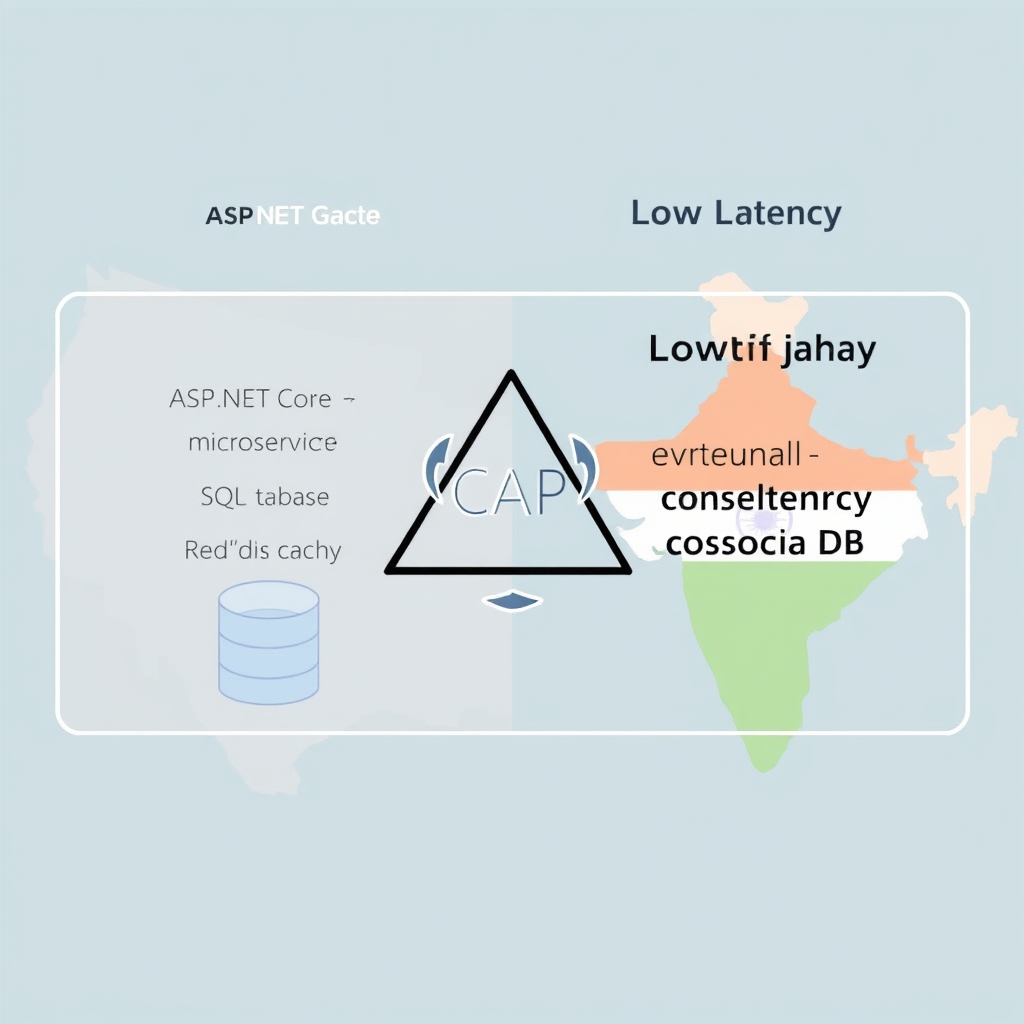
CAP Theorem Trade-Offs in .NET Microservices: Cosmos DB vs Redis
Quick Answer
Balance consistency and latency per service in .NET microservices using Cosmos DB, Redis, and observability to meet business constraints.
Quick Answer
CAP Theorem Trade-Offs in .NET Microservices: Balance consistency and latency per service in .NET microservices using Cosmos DB, Redis, and observability to meet business constraints.
Quantifying Partition Costs in .NET Microservices
In a distributed .NET stack, the moment you decide which side of the CAP triangle to trade for is the moment you start paying for it. The choice is not a design‑time “nice‑to‑have” but a runtime cost that surfaces as timeouts, stale data, or regulatory infractions. The real question is: what is the cost of a partition for your service and how do you quantify it?
Real‑World Example: A Global E‑Commerce Checkout vs. a Live‑Chat API
Consider two services that live side‑by‑side in the same architecture but serve different business goals:
- Checkout API – must never double‑charge, must honour inventory in real time. The business rule is a hard constraint: write‑after‑write consistency is mandatory.
- Live‑Chat API – delivers commentary to 5M concurrent users. The business rule tolerates a few seconds of stale data as long as the user sees a comment within 200 ms.
Both services run on Azure Kubernetes Service (AKS), use Cosmos DB, and are exposed via Azure API Management. The same CAP decision that works for checkout breaks the chat service and vice‑versa.
Trade‑offs in the .NET Context
In .NET you can map CAP to concrete tooling choices:
- Consistency – SQL Server with
READ COMMITTED SNAPSHOT, Cosmos DBStrong, or a Raft‑based cluster (e.g.,Consul+EF Core). - Availability – keep‑alive health probes, Azure Traffic Manager, or
Kestrelwith multiple replicas. - Partition Tolerance – network isolation, VNet peering, and
Azure Service BuswithRetryPolicy.
Choosing strong consistency typically means a single write path that may hit a primary node, which can become a bottleneck during a network split. Opting for eventual consistency gives you a low‑latency read path but introduces staleness that you must manage.
Prioritise Consistency or Latency with Constraints
- Define the business constraint. Is there a regulatory requirement? Do you need
read-after-writeguarantees? If yes, default to consistency. - Quantify the latency budget. For the chat API, 200 ms is the hard cut‑off. For the checkout API, 150 ms is the sweet spot to avoid a double‑charge window.
- Measure replication lag. In Cosmos DB,
Sessionconsistency gives~20 mslag;Eventualcan be5–10 sunder load. If your staleness tolerance is1 s,Sessionis the only viable option. - Pick the data store pattern. For strong consistency, use
SQL Server Always OnorCosmos Strong. For low latency, use a cache‑aside pattern with Redis and aWrite‑Throughpolicy if you need near‑real‑time freshness. - Implement a compensating saga. When you cannot have a single ACID transaction across services, orchestrate with a saga that rolls back on failure. The saga’s own latency is a second trade‑off.
- Observe and alert. Instrument
staleness_secondsandlatency_msmetrics, and set alerts for spikes that exceed the defined thresholds.
When This Fails in Production
- **Partition + High Load** – During a VNet outage, all replicas in a region go offline. If you’re using strong consistency, every request hits the primary node, causing a cascade of timeouts that propagate to the API layer.
- **Cache Invalidation Lag** – A write that updates the primary store but fails to invalidate the cache within
100 msleads to stale reads. In a chat service, this manifests as duplicate comments or out‑of‑order messages. - **Saga Timeout** – If a compensating action takes longer than the saga’s timeout window, you end up with orphaned inventory reservations or unrefunded payments.
Common Mistakes Engineers Make
- Assuming that “eventual consistency” is the default when you use Cosmos DB. In reality, you must explicitly choose the consistency level and understand its replication semantics.
- Over‑optimising for latency by disabling retries. A single transient failure can break a consistency guarantee if you swallow the error.
- Using a single Redis cache for all services. Hot keys in one service can starve the cache for another, leading to higher cache miss rates.
- Neglecting to propagate correlation IDs across services. Without
traceparentheaders, you cannot correlate a stale read with the write that caused it.
Better Approach Based on Experience
In production environments I've seen a hybrid pattern that balances consistency and latency without forcing a single decision for the entire fleet:
- Primary‑Replica Per Region – Each service has a primary node for writes and one or more read replicas. Write traffic is routed to the primary; reads are served from the nearest replica.
- Cache‑Aside with TTL + Immediate Invalidation – Cache writes are followed by an immediate key delete. The TTL is kept short (
2 s) to guard against accidental stale data during a partition. - Event‑Driven Outbox + Background Sync – All state changes are written to an outbox table inside the same transaction as the business write. A lightweight background worker publishes the event and updates any read models or caches.
- Dynamic Consistency Switching – For critical writes, the service temporarily elevates consistency (e.g.,
Strongin Cosmos) and falls back toSessionfor bulk analytics updates. - Observability‑First – Every request logs the chosen consistency level, latency, and staleness metrics. Alerts fire when staleness exceeds
5 sor latency breaches the 90th percentile budget.
| Option | Consistency Guarantee | Latency Implication | Observability Benefit |
|---|---|---|---|
| Cosmos DB Strong Consistency | Latest data on every read | Higher latency (replication round‑trip) | Precise tracing of data reads in Application Insights |
| Cosmos DB Bounded Staleness | Stale data bounded by configured delay | Moderate latency (replication delay) | Monitoring staleness window via metrics |
| Cosmos DB Eventual Consistency | No immediate consistency guarantees | Low latency (no replication wait) | Metrics to detect stale reads in Prometheus |
| Redis Cache‑aside | Cache‑only, eventual sync with DB | Very low latency (in‑memory) | Cache‑miss alerts in Grafana |
Performance Considerations & Scaling Notes
- Write Path Overhead – Strong consistency typically adds a round‑trip to the primary node. In a globally distributed AKS cluster, this can add
40–60 msper write. Scale the primary by adding read replicas and using Azure SQL elastic pools to absorb burst traffic. - Read Path Latency – Cache‑aside reduces read latency to
<10 msfor hot keys. However, the cost of cache misses (DB read + cache write) can spike during a cache warm‑up period. UseCache‑Asidewith pre‑fetching for predictable hot sets. - Replica Lag – In Cosmos DB,
Read‑Your‑Writescan be achieved withStrong, but at the expense of higher write throughput. If you need~5 slag tolerance,EventualwithChange Feedprocessing can keep read models fresh. - Network Partition Detection – Implement health probes that check
Service BusandAzure SQLconnectivity. If a partition is detected, switch read traffic to the nearest replica and surface a degraded mode to the API layer. - Cost vs. Latency Trade‑off – Strong consistency on Cosmos DB costs 1.5–2× more for the same throughput compared to eventual. If you can tolerate a
5 sstaleness window, you can reduce read units by 40% and save on the budget.
How does choosing strong consistency affect write latency in a globally distributed AKS cluster using Cosmos DB?
Strong consistency forces a write to reach the primary node before responding. In a global AKS cluster with Cosmos DB, that adds a round‑trip (~40–60 ms) per write and can become a bottleneck during a network split.
What observability metrics should I collect to detect consistency vs latency trade‑offs in .NET microservices?
Collect staleness_seconds, latency_ms, consistency_level metrics per request, and set alerts for latency > budget or staleness > threshold. Use Application Insights or Prometheus with OpenTelemetry.
How can I implement dynamic consistency switching for critical writes without adding latency overhead?
Configure Cosmos DB to switch between Strong and Session consistency at runtime based on a request header or feature flag. Keep the write path unchanged; only the consistency level is adjusted, adding negligible latency.
What are the risks of using a single Redis cache across multiple services in a CAP‑aware architecture?
A single Redis cache can lead to hot‑key contention, cache‑miss storms, and stale data if invalidation is delayed. Isolate caches per service or use a sharded cluster to avoid these pitfalls.
How do compensating sagas influence the overall latency budget when consistency cannot be guaranteed?
Compensating sagas introduce additional round‑trips and potential timeouts. Each saga step adds ~50–100 ms, so you must include saga latency in the overall SLA and set appropriate timeouts to prevent orphaned state.
What to Ship
- Add a partition‑awareness metric to your service health endpoint that reports the current network latency between the service and its primary database node; set a threshold of
200ms beyond which the service automatically switches to read‑replica mode. - Configure Entity Framework Core to use
ReadCommittedisolation for high‑latency regions andSnapshotfor low‑latency regions; verify the setting via a unit test that asserts the isolation level. - Implement a feature flag that toggles between strong consistency and eventual consistency for the checkout flow; store the flag in a distributed cache and refresh it every
30seconds. - Add a retry policy with exponential backoff and a maximum of 3 attempts for write operations that fail due to consistency conflicts; log each retry attempt with correlation IDs.
- Create a scheduled job that runs every 15 minutes to detect and repair data skew caused by partitioned writes; the job should log the number of records repaired.
- Update your deployment pipeline to include a step that validates the partition tolerance setting by simulating a network partition using a Chaos Monkey tool; the pipeline should fail if the service cannot maintain its defined consistency level.
Conclusion: CAP Is a Decision Matrix, Not a Design Constraint
In a .NET microservice fleet, the CAP trade‑off is a decision matrix that should be revisited with every new feature or traffic spike. The right approach is to keep consistency and latency as separate knobs that you can tune per service, backed by a robust observability stack that surfaces the cost of each knob in real time. By doing so, you avoid the common pitfalls of over‑optimisation and under‑protecting critical business data.
Related Articles
- Self-Attention vs. Cross-Attention in .NET RAG: Architectural Trade‑offs You Must Know
- MCP Server vs Function Calling .NET AI Integrations: What Really Changes in Production
- Scalable Video Streaming Architecture: Micro‑services vs Monolith
- MCP Server Architecture: Managing Tenant Context & Token Budgets
- Guardrails and Red‑Teaming for LLM Features in .NET Applications – A Production‑Ready Playbook
Frequently Asked Questions
How does choosing strong consistency affect write latency in a globally distributed AKS cluster using Cosmos DB?
Strong consistency forces a write to reach the primary node before responding. In a global AKS cluster with Cosmos DB, that adds a round‑trip (~40–60 ms) per write and can become a bottleneck during a network split.
What observability metrics should I collect to detect consistency vs latency trade‑offs in .NET microservices?
Collect staleness_seconds, latency_ms, consistency_level metrics per request, and set alerts for latency > budget or staleness > threshold. Use Application Insights or Prometheus with OpenTelemetry.
How can I implement dynamic consistency switching for critical writes without adding latency overhead?
Configure Cosmos DB to switch between Strong and Session consistency at runtime based on a request header or feature flag. Keep the write path unchanged; only the consistency level is adjusted, adding negligible latency.
What are the risks of using a single Redis cache across multiple services in a CAP‑aware architecture?
A single Redis cache can lead to hot‑key contention, cache‑miss storms, and stale data if invalidation is delayed. Isolate caches per service or use a sharded cluster to avoid these pitfalls.
How do compensating sagas influence the overall latency budget when consistency cannot be guaranteed?
Compensating sagas introduce additional round‑trips and potential timeouts. Each saga step adds ~50–100 ms, so you must include saga latency in the overall SLA and set appropriate timeouts to prevent orphaned state.