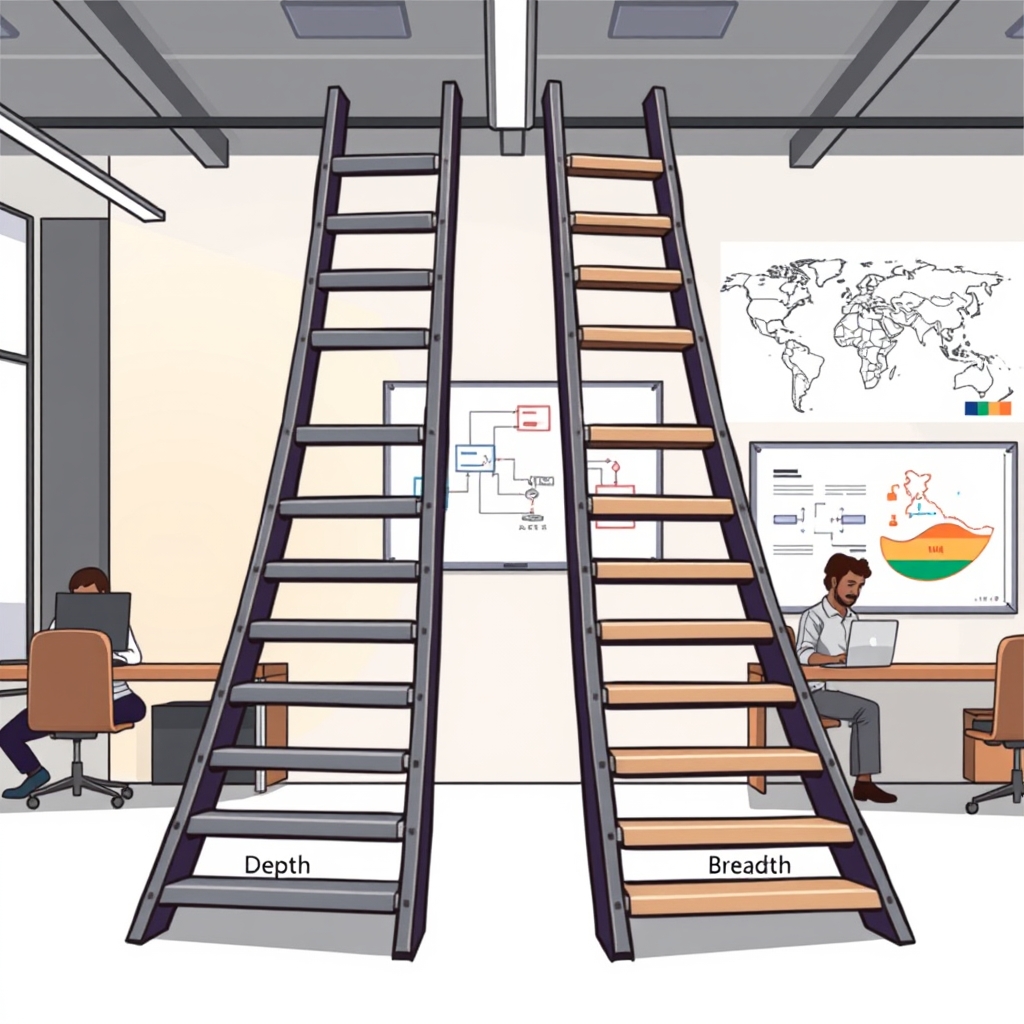
Depth vs Breadth Goals for Software Engineers: When to Specialize, When to Generalize
Quick Answer
Depth vs breadth is a tactical choice for senior engineers—focus on a single subsystem for high ROI, or spread across services for broader impact. Balancing both reduces MTTR and keeps tech debt under control.
Quick Answer
depth vs breadth goals for software engineers: Depth vs breadth is a tactical choice for senior engineers—focus on a single subsystem for high ROI, or spread across services for broader impact. Balancing both reduces MTTR and keeps tech debt under control.
Depth vs Breadth: Tactical Choices for Senior Engineers
Senior engineers sit at the intersection of product velocity and system reliability. The classic depth‑vs‑breadth debate isn’t a career choice; it’s a tactical decision that shapes how you solve real production problems, how you influence architecture, and how you survive tech debt cycles. In a world where services grow from a handful to dozens, a narrow focus can turn you into a single‑point of failure. Conversely, a shallow, broad skill set can make you a jack‑of‑all‑trades who never owns a critical piece of the stack.
Real‑World Example: The FinTech Order‑Matching Engine
A mid‑size fintech had a monolithic order‑matching service written in .NET 4.8. The service was the bottleneck for latency‑sensitive trades. A senior engineer, Depth‑Specialist Dave, spent months refactoring the lock‑contention hotspot in the in‑memory order book. He introduced a sharded lock strategy, moved to a concurrent dictionary with custom comparers, and tuned GC settings. The result: average latency dropped from 12 ms to 3 ms and throughput doubled.
However, the platform later migrated to a micro‑service architecture on Kubernetes. Dave’s deep knowledge of the in‑memory engine became irrelevant because the new services now used a distributed Redis cache. The team had to bring in a new engineer to bridge the gap between the legacy code and the new infra. Meanwhile, Breadth‑Engineer Maya had been pairing across domains, learning Go for the new services, Terraform for infra, and Prometheus for observability. She could immediately start troubleshooting the new latency spike caused by a mis‑configured Service Mesh without waiting for a specialist.
Performance Considerations
- Latency budgets must be defined in the context of the end‑user (e.g., ≤5 ms for high‑frequency trades). A deep dive into GC tuning can shave milliseconds, but only if the service is the bottleneck.
- Throughput gains from a depth fix are often service‑specific. If the service is behind a load balancer, the improvement may be masked by network jitter.
- Cost of maintaining a deep specialization can be high: specialized knowledge may require dedicated training, tooling, and dedicated on‑call time.
Scaling Notes
- Micro‑services expose contract boundaries. Depth in a single service does not automatically scale to a distributed system unless you also understand the message format, retry policies, and observability hooks.
- When scaling horizontally, shared state becomes a pain point. A deep specialist must consider how to de‑centralize state or adopt eventual consistency patterns.
- Observability is a prerequisite for scaling: metrics, traces, and logs must be collected across the stack. Breadth in monitoring tooling can prevent a depth engineer from diagnosing cross‑service latency spikes.
Trade‑offs: Depth vs Breadth
- Impact vs Visibility – Depth can deliver high ROI on a single subsystem, but the engineer’s influence is limited to that domain. Breadth allows cross‑team influence but dilutes deep impact.
- Learning Curve vs Time‑to‑Value – A deep dive into a new language or framework can take months, whereas a breadth skill (e.g., Terraform basics) can be acquired in weeks but may not yield a measurable business outcome.
- Risk of Skill Lock‑In – Deep specialists can become stranded if the underlying technology is deprecated. Breadth mitigates this but can lead to “generalist fatigue” where the engineer never masters anything.
- Cost of On‑Call & Incident Response – Depth engineers often own the most critical services; they may be on‑call more frequently. Breadth engineers spread incident load but may lack the expertise to resolve deep bugs quickly.
When This Fails in Production
1. Depth‑Only Failure: Dave’s lock‑contention fix was buried behind a new Service Mesh that introduced its own latency. Without knowledge of the mesh, he couldn’t diagnose the spike, leading to an MTTR increase from 7 min to 45 min for a critical incident.
2. Breadth‑Only Failure: Maya’s quick fix of the Service Mesh configuration introduced a subtle race condition in the Redis cache, causing intermittent data corruption that surfaced only under load. The bug went unnoticed for weeks because the monitoring alerts were only tuned for latency, not data integrity.
Common Mistakes Engineers Make
- Assuming depth in one language or platform automatically translates to depth in a distributed system.
- Adding breadth without anchoring it to a delivery: “I can use Terraform” but never writes a module for a real service.
- Over‑optimizing for a single metric (e.g., GC tuning) without validating that the metric correlates to user‑visible performance.
- Neglecting observability when scaling: adding more services but not exposing correlated traces.
- Failing to document deep knowledge in ADRs or runbooks, causing knowledge loss when the specialist moves.
Better Approach Based on Experience
- Hybrid Learning Cadence: Allocate 70% of time to deep tech spikes on high‑impact subsystems and 30% to cross‑domain pairing. This keeps the skill set fresh and ensures the engineer remains a trusted owner.
- Rotation on‑call: Rotate incident ownership across services every quarter. Depth engineers learn the surface of other services; breadth engineers get deep dives.
- Observability First: Before diving into performance tuning, instrument the system with distributed tracing (e.g., OpenTelemetry) and ensure that every service emits correlated logs. This turns a depth engineer into a “performance detective” rather than a “performance tinkerer.”
- Document & Share: Write ADRs for every major change, especially those that alter contract boundaries. Publish runbooks for common incidents. This reduces the risk of skill lock‑in and accelerates onboarding.
- Metrics‑Driven Decision Making: Tie every depth effort to a KPI that matters to the business (e.g., latency percentiles, error rates, cost per transaction). If the KPI doesn’t improve, pivot to another area.
Scope ROI Team Career
- Define the Problem Scope – Is the issue localized to a single service or does it span multiple domains? If the latter, breadth wins.
- Assess Business Impact – Quantify the ROI of a potential fix. If a depth fix can save $2M per quarter, it’s a high‑priority deep dive.
- Check Team Maturity – In a mature micro‑service org with mature observability, depth specialists can thrive. In a start‑up with rapid feature churn, breadth is more valuable.
- Consider Career Trajectory – If you aim for Principal Engineer on a platform, depth in that platform is essential. If you’re targeting Staff Engineer with product ownership, breadth is key.
- Evaluate Technical Debt Landscape – High debt in a critical service calls for depth. Low debt but many inter‑service contracts calls for breadth.
- Balance with Knowledge Sharing – Schedule quarterly “knowledge transfer” sessions where depth engineers present their findings to the team. This spreads depth without sacrificing it.
- Iterate on the Cadence – After each sprint, review the impact of depth vs breadth work. Adjust the split if one area consistently delivers higher ROI.
Performance & Scaling Checklist
- Is the latency improvement visible to the end‑user or just an internal metric?
- Did the fix scale horizontally without introducing new bottlenecks?
- Are the observability signals (metrics, traces, logs) correlated across services?
- Did the change affect cost per transaction or resource utilization?
- Is the solution documented and repeatable?
What is the primary difference between depth and breadth goals for software engineers?
Depth goals focus on mastering a single domain or technology stack to deliver high ROI on a specific subsystem, whereas breadth goals spread knowledge across multiple domains to increase cross‑team influence and adaptability.
When should a senior engineer prioritize depth over breadth?
Prioritize depth when the issue is isolated to a high‑impact service, the team is mature with strong observability, and the business can benefit from a deep performance or reliability improvement.
How can breadth help mitigate skill lock‑in?
By learning adjacent technologies (e.g., infrastructure, observability, new languages), engineers can pivot when the underlying tech deprecates, keeping their value high across the organization.
What are the key trade‑offs between depth and breadth in incident response?
Depth engineers often own critical services and may be on‑call more frequently; breadth engineers spread incident load but may lack the deep knowledge to resolve complex bugs quickly.
How can an engineer balance depth and breadth in their daily work?
Adopt a hybrid cadence (70% deep spikes, 30% cross‑domain pairing), rotate on‑call ownership, document ADRs/runbooks, and tie every effort to a business KPI to keep ROI visible.
Balancing Depth and Breadth for Impact
Depth and breadth are not mutually exclusive; they are complementary levers. A senior engineer who can own a high‑impact subsystem with deep expertise while also understanding the contract and observability of the surrounding services can drive both technical excellence and product velocity. The key is to make the trade‑offs explicit, anchor every new skill to a shipped outcome, and keep the focus on measurable business impact. By doing so, you avoid the pitfalls of skill lock‑in, reduce incident MTTR, and position yourself as a true leader in the engineering organization.
Related Articles
- AI Architecture Transition from Prototype to Production: A Senior Engineer’s Playbook
- Scalable Guardrail Service ASP.NET Core Kubernetes: Architecture, Code, and Ops
- Agentic AI Customer Support Platform Architecture: A Production‑Ready Design Walkthrough
- Payment Processing Idempotency: Why Redis Cache Can Fail in Production
- I Built a System to Grade My AI Grader. I Never Gave It Anything to Grade Against: The Missing Benchmark for an AI Interview Evaluator
Frequently Asked Questions
What is the primary difference between depth and breadth goals for software engineers?
Depth goals focus on mastering a single domain or technology stack to deliver high ROI on a specific subsystem, whereas breadth goals spread knowledge across multiple domains to increase cross‑team influence and adaptability.
When should a senior engineer prioritize depth over breadth?
Prioritize depth when the issue is isolated to a high‑impact service, the team is mature with strong observability, and the business can benefit from a deep performance or reliability improvement.
How can breadth help mitigate skill lock‑in?
By learning adjacent technologies (e.g., infrastructure, observability, new languages), engineers can pivot when the underlying tech deprecates, keeping their value high across the organization.
What are the key trade‑offs between depth and breadth in incident response?
Depth engineers often own critical services and may be on‑call more frequently; breadth engineers spread incident load but may lack the deep knowledge to resolve complex bugs quickly.
How can an engineer balance depth and breadth in their daily work?
Adopt a hybrid cadence (70% deep spikes, 30% cross‑domain pairing), rotate on‑call ownership, document ADRs/runbooks, and tie every effort to a business KPI to keep ROI visible.