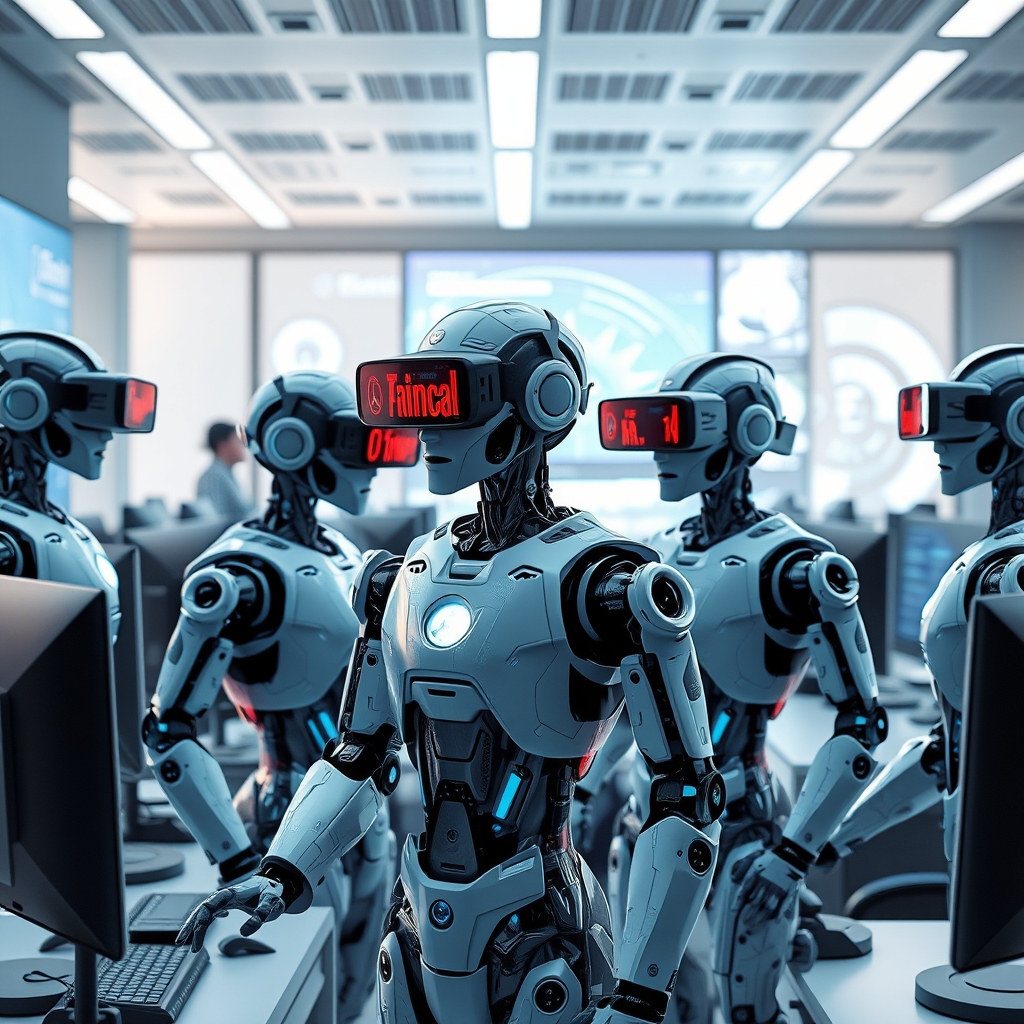
## Navigating the Uncharted Territory of
AI-driven workforce transformation
The future of work is rapidly changing, driven by the increasing adoption of Artificial Intelligence (AI). As AI assumes more responsibilities, the nature of employment and collaboration is shifting. In this guide, we'll explore the impact of AI on the modern workplace and provide actionable insights for thriving in the AI-driven tech industry.
### The AI Revolution: Unlocking Productivity and Innovation in the Modern Workplace
The AI revolution is transforming the modern workplace by unlocking productivity and innovation. By automating repetitive tasks, AI enables employees to focus on high-value tasks, leading to increased efficiency and productivity. Moreover, AI-driven insights and analytics help organizations make informed decisions, driving innovation and growth.
#### The Convergence of Emerging Technologies: AI, Machine Learning, and Automation
The convergence of AI, Machine Learning (ML), and automation is driving the AI revolution. AI combines ML algorithms with automation to create intelligent systems that can learn, reason, and interact with humans. This convergence is leading to the development of AI-driven workflows and task productivity, enhancing collaboration and creativity.
#### Unlocking Human Potential: AI's Role in Enhancing Collaboration and Creativity
AI is not just a replacement for human workers but also a tool to enhance collaboration and creativity. By automating routine tasks, AI enables employees to focus on high-value tasks that require creativity and problem-solving skills. Moreover, AI-driven tools facilitate collaboration, enabling teams to work together more effectively and drive innovation.
### The Imperative of AI Adoption: Embracing Transformation and Innovation in the US Tech Industry
The US tech industry is at the forefront of AI adoption, with many organizations embracing AI-driven transformation and innovation. However, AI adoption is not without challenges, and organizations must navigate common pitfalls and mistakes in AI implementation. In this guide, we'll explore the imperative of AI adoption and provide actionable insights for a successful AI implementation.
#### Navigating Regional Variations in AI Adoption: A Comparative Analysis of the US, India, Europe, Australia, and Africa
Regional variations in AI adoption exist, and organizations must navigate these differences when implementing AI. A comparative analysis of the US, India, Europe, Australia, and Africa reveals unique AI adoption patterns, challenges, and opportunities. In this guide, we'll explore regional variations in AI adoption and provide insights for successful AI implementation.
#### Assessing the Impact of AI on Job Displacement and Upskilling: Insights from the India Tech Industry
The India tech industry is experiencing significant job displacement and upskilling due to AI adoption. However, AI is also creating new job opportunities and skills. In this guide, we'll explore the impact of AI on job displacement and upskilling in the India tech industry and provide insights for organizations to adapt to the changing job market.
### Practical Applications of AI in Software Development: Leveraging Emerging Technologies for Business Growth
AI is transforming software development by providing practical applications for business growth. By leveraging AI in software development, organizations can enhance collaboration, creativity, and productivity. In this guide, we'll explore practical applications of AI in software development and provide actionable insights for organizations to leverage AI for business growth.
#### Real-World Examples of AI in Software Development: Code Examples and Step-by-Step Implementations
Real-world examples of AI in software development are abundant, and organizations can learn from these examples to implement AI successfully. In this guide, we'll provide code examples and step-by-step implementations of AI in software development, enabling organizations to leverage AI for business growth.
### Best Practices for AI Development: Ensuring Scalability, Security, and Reliability
AI development requires best practices that ensure scalability, security, and reliability. Organizations must navigate common pitfalls and mistakes in AI implementation to ensure successful AI development. In this guide, we'll explore best practices for AI development and provide actionable insights for organizations to ensure scalability, security, and reliability in AI development.
#### Common Pitfalls and Mistakes in AI Implementation: Learn from the Experiences of Tech Giants
Tech giants have experienced common pitfalls and mistakes in AI implementation, providing valuable lessons for organizations. In this guide, we'll explore common pitfalls and mistakes in AI implementation and provide insights for organizations to learn from the experiences of tech giants.
### Performance and Architecture Considerations for AI Systems: Optimizing for Scalability and Efficiency
AI systems require performance and architecture considerations to optimize for scalability and efficiency. Organizations must navigate these considerations to ensure successful AI implementation. In this guide, we'll explore performance and architecture considerations for AI systems and provide actionable insights for organizations to optimize for scalability and efficiency.
#### Optimizing AI System Performance: A Comparative Analysis of Architecture and Design Approaches
Optimizing AI system performance is critical for successful AI implementation. A comparative analysis of architecture and design approaches reveals unique insights for optimizing AI system performance. In this guide, we'll explore optimizing AI system performance and provide actionable insights for organizations to achieve optimal AI system performance.
### Ensuring AI System Reliability: Strategies for Fault Tolerance and Error Handling
AI system reliability is critical for successful AI implementation. Organizations must navigate strategies for fault tolerance and error handling to ensure AI system reliability. In this guide, we'll explore ensuring AI system reliability and provide actionable insights for organizations to achieve AI system reliability.
#### FAQs: Uncovering the Truths and Myths Surrounding AI and the Future of Work
Frequently Asked Questions (FAQs) help organizations understand the truths and myths surrounding AI and the future of work. In this guide, we'll provide FAQs and insights for organizations to navigate the truths and myths surrounding AI and the future of work.
### PAA Question 1: What are the key benefits of AI adoption in software development?
The key benefits of AI adoption in software development include enhanced collaboration, creativity, and productivity. AI-driven insights and analytics help organizations make informed decisions, driving innovation and growth. Moreover, AI automates repetitive tasks, enabling employees to focus on high-value tasks.
### PAA Question 2: How can tech companies mitigate the risks of AI implementation?
Tech companies can mitigate the risks of AI implementation by navigating common pitfalls and mistakes in AI implementation. Organizations must ensure scalability, security, and reliability in AI development and implement performance and architecture considerations to optimize for scalability and efficiency.
## Conclusion
The future of work is rapidly changing, driven by the increasing adoption of AI. Organizations must navigate the impact of AI on employment and collaboration to thrive in the AI-driven tech industry. In this comprehensive guide, we've explored the AI revolution, AI adoption, and implementation, and provided actionable insights for a successful AI implementation. As discussed in our guide to 'Thriving in the AI-Driven Tech Industry: Career Growth, Job Market, and Innovation', AI is transforming the modern workplace, and organizations must adapt to these changes to succeed.
What role will AI play in the future of work?
The future of work is rapidly changing, driven by the increasing adoption of Artificial Intelligence (AI). As AI assumes more responsibilities, the nature of employment and collaboration is shifting, leading to a more efficient and productive workforce.
How will AI impact the nature of employment and collaboration?
AI will change the nature of employment and collaboration by automating repetitive tasks, enabling employees to focus on high-value tasks, and facilitating more effective collaboration among team members.
What are the benefits of AI in the modern workplace?
The benefits of AI in the modern workplace include increased productivity, improved decision-making, and enhanced innovation, all of which are critical to thriving in the AI-driven tech industry.
Will AI replace human workers or augment their capabilities?
While AI will certainly change the nature of work, it is more likely to augment human capabilities, freeing employees from mundane tasks and enabling them to focus on high-value tasks that require creativity, empathy, and problem-solving skills.
What skills will be required to succeed in the AI-driven workforce?
To succeed in the AI-driven workforce, individuals will need to develop skills that are complementary to AI, such as critical thinking, creativity, and emotional intelligence, as well as a strong understanding of AI technologies and their applications.
How can organizations prepare for the future of work and the impact of AI?
To prepare for the future of work and the impact of AI, organizations should invest in AI education and training programs, re-evaluate their job requirements and processes, and focus on developing a culture of innovation and collaboration.
What are the potential risks and challenges associated with AI adoption in the workplace?
The potential risks and challenges associated with AI adoption in the workplace include job displacement, bias and error in AI decision-making, and the need for ongoing training and education to ensure that employees have the skills required to work effectively with AI technologies.