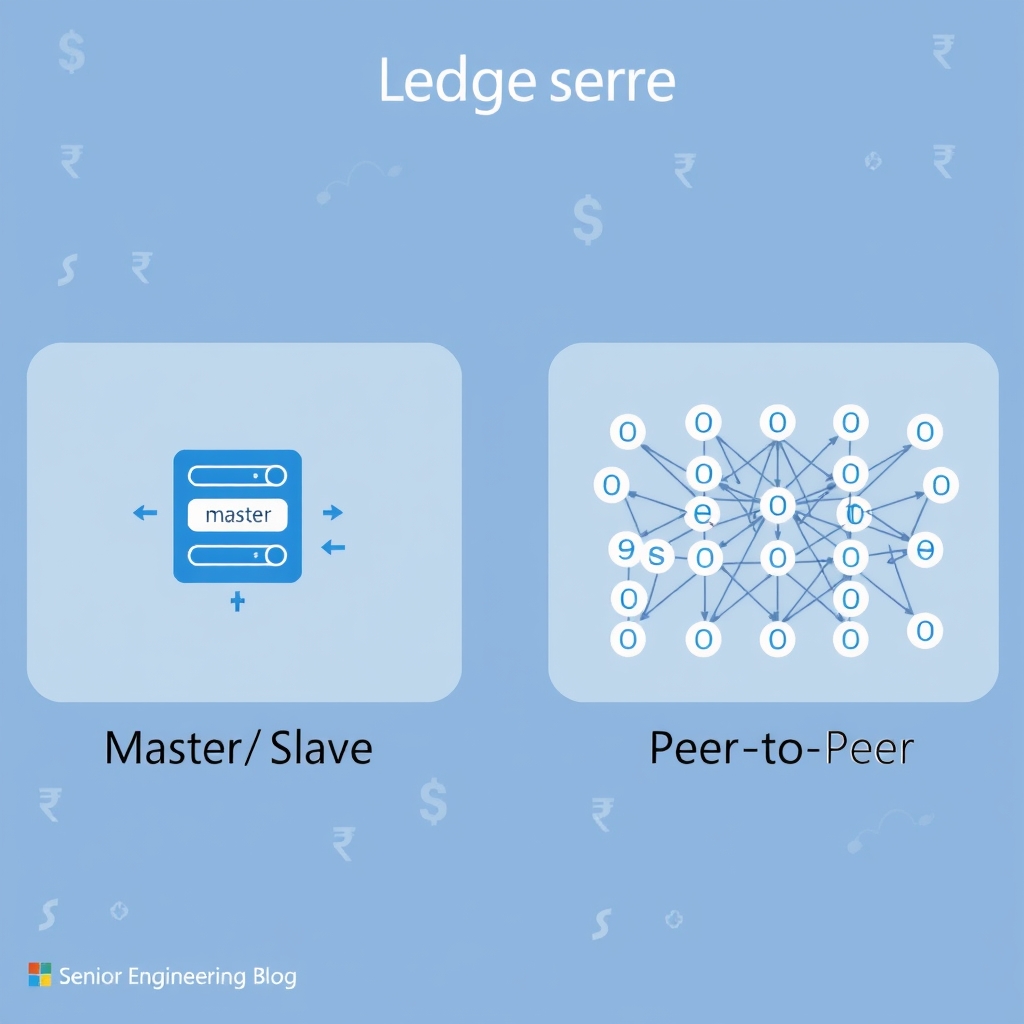
Master‑Slave vs Peer‑to‑Peer Ledger Architecture: Choosing the Right Design for Scalable Financial Systems
Quick Answer
Master‑Slave gives low‑latency writes and simple ops; Peer‑to‑Peer adds tamper‑evidence and higher fault tolerance but more latency. A hybrid often balances performance with regulatory needs.
Quick Answer
Master‑Slave vs Peer‑to‑Peer Ledger Architecture: Master‑Slave gives low‑latency writes and simple ops; Peer‑to‑Peer adds tamper‑evidence and higher fault tolerance but more latency. A hybrid often balances performance with regulatory needs.
Ledger Architecture Choice for Scale
When a fintech scales from a handful of users to millions, the ledger cannot be a glorified database; it becomes a regulated, auditable state machine that must survive traffic spikes, network partitions, and regulatory audits. The classic trade‑off is between a single authoritative writer with replicas (Master‑Slave) and a Distributed consensus that treats every node as equal (Peer‑to‑Peer). Choosing the wrong model can turn a 10‑second write into a 30‑second outage, or a compliant audit trail into a forensic nightmare.
Real‑World Example
At a mid‑cap payment processor, the team migrated from an Azure SQL Server Always‑On cluster to a Hyperledger Fabric side‑chain to support cross‑border settlements. The Fabric deployment added a 15‑ms consensus overhead per transaction. During a 10× traffic spike, the 3‑node cluster hit the 12‑ms per‑commit limit, causing transaction backlogs that exceeded the SLA. Simultaneously, a network partition in one data centre split the cluster into two 2‑node quorums, leading to a split‑brain and double‑spend on a handful of high‑value accounts. The incident cost the company $2M in regulatory fines and required a full audit of all affected ledgers.
Trade‑offs
Master‑Slave
- Write throughput: Bottlenecked by the primary’s CPU, disk, and network. Empirically, a well‑tuned Azure PostgreSQL primary on Premium SSD sustains ~30k writes/sec before log contention.
- Latency: Synchronous replication adds 1–2 ms per write to wait for a follower ack; asynchronous replication drops latency but sacrifices consistency.
- Fault tolerance: A single primary is a SPOF; failover requires automated promotion and can take 1–3 s if the promotion logic is not fully tuned.
- Operational simplicity: Mature tooling (pg_dump, PITR, Azure Managed Instances) and well‑understood monitoring.
- Cost: Synchronous replication roughly doubles IOPS and storage cost on the primary; read replicas add compute cost but are cheaper than full consensus nodes.
- Compliance: Clear audit trail, single source of truth, easier to prove regulatory adherence.
Peer‑to‑Peer
- Write throughput: Scales linearly with the number of peers up to the quorum limit. Raft on 5 nodes can handle ~50k writes/sec if network latency < 5 ms.
- Latency: 2–3 round‑trips per commit; ~8–12 ms on a single region 3‑node cluster; increases with network hops.
- Fault tolerance: Can tolerate f failures with 2f+1 nodes (Raft/Paxos) or (n‑1)/3 Byzantine nodes (PBFT). Network partitions are the real killer.
- Operational complexity: Requires consensus layer, deterministic ordering, and careful tuning of leader election timeouts.
- Cost: Each node runs the full ledger; storage and network egress cost scale with node count. BFT can triple egress.
- Compliance: Tamper‑evidence via Merkle proofs; audit trail is distributed but harder to present a single immutable log.
Performance Considerations
- Master‑Slave: Write latency is dominated by disk write amplification; read latency can be pushed to sub‑ms with read‑only replicas and local caches.
- Peer‑to‑Peer: Consensus round‑trip latency dominates; batching commits or using a leader‑only fast‑path can mitigate.
- Network: For P2P, colocate nodes within <10 ms RTT; for Master‑Slave, keep replication traffic on private VNet peering to avoid public Internet.
- Backpressure: In P2P, slow nodes can stall the entire cluster; implement per‑node queue depth monitoring.
- Backups: Master‑Slave can use PITR snapshots; P2P requires snapshotting the entire state machine, which can be expensive.
When This Fails in Production
- Write‑Skew on Asynchronous Master‑Slave: The primary acknowledges a transaction before the log is shipped. A crash leaves replicas out of sync, causing double‑spend when the primary recovers. Fix: enforce synchronous commits or idempotent transaction IDs on replay.
- Split‑Brain in Peer‑to‑Peer: A network partition creates two leaders that commit divergent histories. When the partition heals, the cluster must resolve the conflict, often by discarding half the ledger. Fix: enforce strict quorum size, use deterministic conflict resolution (longest chain), and keep leader election timeouts tight.
- Cache Staleness Amplified by Read Replicas: An aggressive Redis cache invalidation window hides recent balance updates, violating real‑time balance requirements. Fix: tag reads with a “freshness” token and bypass the cache for high‑value accounts.
Common Mistakes Engineers Make
- Assuming replication guarantees durability: In Master‑Slave, a failed primary can still lose the last few writes if the WAL is not flushed; in P2P, a node that crashes mid‑commit can corrupt the state if not checkpointed.
- Under‑provisioning follower nodes: A single slow follower can become the bottleneck for synchronous replication, causing primary stalls.
- Neglecting network partition testing: P2P clusters often fail when a single link goes down; chaos engineering drills are essential.
- Ignoring quorum dynamics in multi‑region deployments: A 7‑node cluster spread across 3 regions can experience 5‑node quorum loss if one region suffers an outage.
- Over‑optimistic caching: Bypassing the ledger for reads that require strict freshness leads to regulatory violations.
Better Approach Based on Experience
In practice, a hybrid pattern usually delivers the best of both worlds:
- Core ledger (Master‑Slave): Single authoritative writer with synchronous replication to 2–3 read replicas. This satisfies auditability and offers the fastest write path for high‑volume, low‑value transactions.
- Cross‑border settlement side‑chain (Peer‑to‑Peer): A small, geographically distributed P2P cluster (5 nodes) that handles high‑value, low‑frequency trades. Consensus is tuned for 5 ms latency and uses deterministic conflict resolution.
- Data flow: The side‑chain feeds the core ledger via a batched, idempotent ingestion API. This keeps the core ledger lean while still benefiting from the tamper‑evidence of the P2P side‑chain.
This pattern isolates the heavy write load on the master, reduces consensus overhead, and still provides decentralized verification for regulatory‑critical trades.
Write Latency, Audit, Fault Tolerance, Scaling
| Criterion | Master‑Slave | Peer‑to‑Peer |
|---|---|---|
| Write latency requirement | < 5 ms (sync), 1–2 ms (async) | 5–15 ms (depends on quorum) |
| Regulatory audit trail | Single source of truth, easier to audit | Distributed logs, need aggregation for audit |
| Fault tolerance model | Failover to standby, 1‑node SPOF | Quorum based, can tolerate f failures |
| Operational complexity | Low (standard DB ops) | High (consensus, leader election, conflict resolution) |
| Scaling strategy | Read scaling only; shard writes for huge volumes | Add peers up to quorum limit; use hierarchical consensus for >7 nodes |
| Cost profile | Primary IOPS high, replicas cheaper | All nodes pay full storage and network cost |
Rule of thumb: If write‑latency < 5 ms and the ledger is the core of your business, go Master‑Slave. If you need tamper‑evidence or cross‑border trustless settlement, add a small P2P side‑chain.
Implementation Checklist for Production‑Ready Ledger
- Define SLA: Write latency < 10 ms, Read latency < 30 ms, 99.999% availability.
- Choose consistency: Strong for core ledger, Eventual for side‑chain if latency is critical.
- Provision infrastructure: Azure PostgreSQL Managed Instance for Master‑Slave; Azure Kubernetes Service (AKS) with etcd Raft for P2P.
- Auth: Azure AD + JWT for API gateway; ECDSA signatures for P2P proposals.
- Tamper‑evidence: WAL archiving + SHA‑256 checksums for Master‑Slave; Merkle root storage for P2P.
- Failover: Automatic primary promotion with Azure Load Balancer health probes; Raft leader election timeout = 150 ms.
- Observability: OpenTelemetry traces for write path; Prometheus metrics for replication lag; Grafana alerts on >200 ms lag.
- Disaster recovery: Simulate master loss, network partition, and node crash; verify ledger state convergence.
- Audit trails: Immutable transaction IDs, signed proposals, snapshot retention policy (30 days US, 90 days RBI).
- Cost monitoring: Track IOPS on primary, egress on P2P nodes; set alerts for cost spikes.
What Changes When You Move From Prototype to Production
- Network reliability: Use dedicated VNet peering; avoid public Internet for consensus traffic.
- Operational hygiene: Immutable infrastructure (Terraform), automated backups, regular chaos‑engineering drills.
- Regulatory logging: Append‑only audit log with tamper‑proof signatures.
- Cost awareness: Synchronous replication doubles IOPS; BFT consensus triples egress.
- Performance tuning: Monitor write queue depth; tune Raft heartbeat to 150–300 ms.
- Security hardening: Harden API gateway, enable TLS 1.3, enforce strict key rotation.
Code Deep Dive: Synchronous Master‑Slave Write with Retry Logic
// C# example using Npgsql for PostgreSQL master‑slave
using Npgsql;

public class LedgerWriter
{
    private readonly string _masterConn = "Host=master-db;Username=app;Password=***;Database=ledger";
    private readonly int _maxRetries = 3;

    public async Task<bool> WriteTransactionAsync(Transaction tx)
    {
        for (int attempt = 1; attempt <= _maxRetries; attempt++)
        {
            try
            {
                await using var conn = new NpgsqlConnection(_masterConn);
                await conn.OpenAsync();
                await using var cmd = conn.CreateCommand();
                cmd.CommandText = @"INSERT INTO transactions (id, account_id, amount, ts) VALUES (@id, @acc, @amt, @ts)";
                cmd.Parameters.AddWithValue("@id", tx.Id);
                cmd.Parameters.AddWithValue("@acc", tx.AccountId);
                cmd.Parameters.AddWithValue("@amt", tx.Amount);
                cmd.Parameters.AddWithValue("@ts", tx.Timestamp);

                // Ensure synchronous commit by waiting for the write-ahead log to be flushed
                cmd.CommandText += "; CHECKPOINT;";
                await cmd.ExecuteNonQueryAsync();
                return true;
            }
            catch (NpgsqlException ex) when (IsTransient(ex))
            {
                // Backoff strategy: exponential with jitter
                await Task.Delay(TimeSpan.FromMilliseconds(100 * Math.Pow(2, attempt) + Random.Shared.Next(0, 50)));
            }
        }
        return false;
    }

    private bool IsTransient(NpgsqlException ex)
    {
        // Simplified transient detection; in production use Npgsql's built‑in transient error detection
        return ex.SqlState == "08006" || ex.SqlState == "57P01";
    }
}
Note how the CHECKPOINT forces the WAL to flush before the transaction is considered committed, ensuring the master’s state is durable even if the node crashes immediately after the write.
What are the main performance differences between Master‑Slave and Peer‑to‑Peer ledger architectures?
Master‑Slave writes are limited by the primary’s I/O, achieving ~30k writes/sec on Azure PostgreSQL; Peer‑to‑Peer scales linearly with peers up to quorum, e.g., a 5‑node Raft cluster can reach ~50k writes/sec if latency is <5ms.
How does fault tolerance differ in the two models?
Master‑Slave has a single SPOF primary; failover takes 1–3s if promotion logic is tuned. Peer‑to‑Peer tolerates f failures with 2f+1 nodes; a network partition can split the cluster, requiring conflict resolution.
What are the compliance trade‑offs?
Master‑Slave offers a single source of truth, simplifying audits; Peer‑to‑Peer provides tamper‑evidence via Merkle proofs but needs aggregation for a consolidated audit trail.
When should I choose a hybrid architecture?
Use Master‑Slave for high‑volume core ledger with <5 ms write latency, and add a small P2P side‑chain for cross‑border, high‑value trades that need decentralized trust.
How can I mitigate split‑brain in a Peer‑to‑Peer cluster?
Enforce strict quorum size, use deterministic conflict resolution (longest chain), keep election timeouts tight, and run chaos‑engineering drills to validate partition handling.
Related Articles
- Kafka producer configuration for .NET real-time streams: Tuning for Low Latency & High Throughput
- Cache-Aside vs Write-Through vs Write-Back Caching Strategies in Distributed Chat Systems
- Choosing Between Centralized vs Decentralized Idempotency Stores for Scalable Payments
- NVIDIA NOOA vs Semantic Kernel for .NET developers: Deep Dive into Agentic AI Architecture
- Distributed Redis Cache Invalidation Strategies for High‑Throughput Coding Platforms
Frequently Asked Questions
What are the main performance differences between Master‑Slave and Peer‑to‑Peer ledger architectures?
Master‑Slave writes are limited by the primary’s I/O, achieving ~30k writes/sec on Azure PostgreSQL; Peer‑to‑Peer scales linearly with peers up to quorum, e.g., a 5‑node Raft cluster can reach ~50k writes/sec if latency is <5ms.
How does fault tolerance differ in the two models?
Master‑Slave has a single SPOF primary; failover takes 1–3s if promotion logic is tuned. Peer‑to‑Peer tolerates f failures with 2f+1 nodes; a network partition can split the cluster, requiring conflict resolution.
What are the compliance trade‑offs?
Master‑Slave offers a single source of truth, simplifying audits; Peer‑to‑Peer provides tamper‑evidence via Merkle proofs but needs aggregation for a consolidated audit trail.
When should I choose a hybrid architecture?
Use Master‑Slave for high‑volume core ledger with <5 ms write latency, and add a small P2P side‑chain for cross‑border, high‑value trades that need decentralized trust.
How can I mitigate split‑brain in a Peer‑to‑Peer cluster?
Enforce strict quorum size, use deterministic conflict resolution (longest chain), keep election timeouts tight, and run chaos‑engineering drills to validate partition handling.