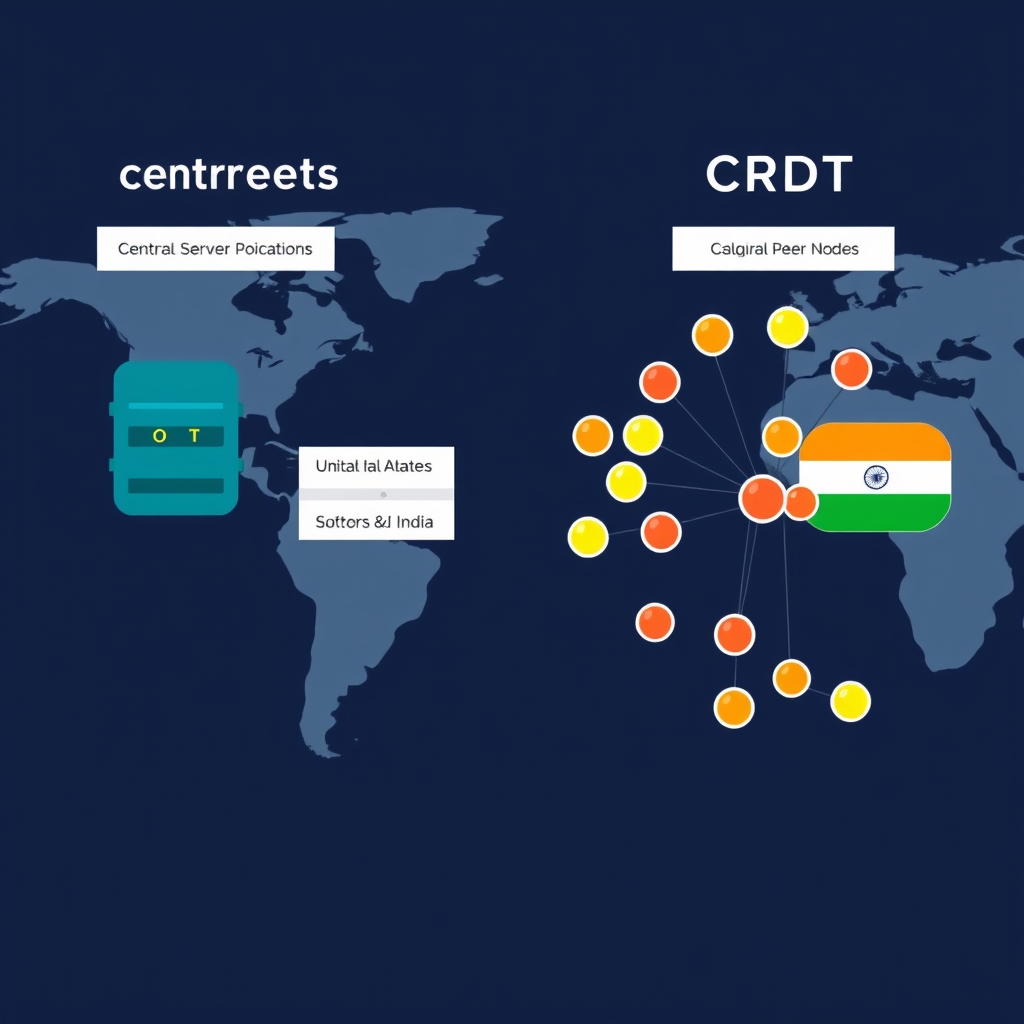
CRDT vs OT for Real-Time Collaboration: When to Choose Which Engine
Quick Answer
Choosing between OT and CRDT hinges on latency, concurrency, and offline needs. OT works for low‑concurrency, low‑latency, always‑online use‑cases; CRDT excels with high concurrency and offline editing.
Quick Answer
CRDT vs OT for real-time collaboration: Choosing between OT and CRDT hinges on latency, concurrency, and offline needs. OT works for low‑concurrency, low‑latency, always‑online use‑cases; CRDT excels with high concurrency and offline editing.
Choosing the Right Engine for Scale
When a collaborative document moves from a handful of users to thousands of concurrent editors, the choice of convergence engine becomes a hard dependency. Operational Transformation (OT) and Conflict‑Free Replicated Data Types (CRDTs) are the two dominant patterns, but they are not interchangeable. A mis‑chosen engine can turn a feature‑rich editor into a latency nightmare, a source of data corruption, or a maintenance burden that kills the product’s release cadence.
Real‑World Example
Consider DocForge, a SaaS that offers real‑time whiteboard and markdown editing for distributed teams. The product launched with a home‑grown OT engine that performed well for 50–100 users per document. Within six months, a new feature allowed field engineers to edit documents offline on low‑bandwidth mobile devices. The OT stack failed to merge edits when users returned, causing UI rollbacks and a spike in support tickets. The engineering team spent weeks debugging a subtle bug in the transformation matrix that only surfaced under a specific conflict pattern. The root cause? The OT engine’s central transformation server became a bottleneck at high concurrency, and the offline buffer logic was brittle.
Trade‑offs
Latency & Concurrency
OT guarantees intention‑preserving convergence but requires a round‑trip to a server that applies T(opA, opB). In a US‑India deployment with 180 ms RTT, each operation can feel like a 360 ms delay, especially when many users edit the same region of a document. CRDTs let clients apply changes locally; the only network AWS-lambda-pricing-models-spend-optimization-and-production-strategies-20261018" class="internal-link">Cost is the periodic gossip of state vectors (typically <50 ms). For documents with >100 simultaneous editors, the OT server becomes a single point of contention, while CRDT merges are embarrassingly parallel.
Offline & Mobile Support
OT needs to buffer the entire operation history for each client until it can re‑transform against the latest server state. If the buffer window is 5 min, a user who edits for 30 min while offline will have a history that the server can’t reconcile, leading to divergent states. CRDTs treat each local edit as a first‑class operation; the client can persist its own state vector and replay it later without any server‑side transformation. In practice, this means Automerge or Yjs clients can commit edits offline, sync in the background, and never lose data.
Implementation Complexity
OT requires a hand‑crafted transformation matrix for every operation type (insert, delete, formatting). The matrix grows as new rich‑text features are added, and any bug can break convergence. CRDT libraries expose a clean API (e.g., Y.Text), but you still need to engineer identifier allocation, tombstone garbage‑collection, and efficient diff broadcast. A common mistake is to rely on the library’s default identifier strategy in a multi‑region setup, resulting in collisions and merge storms.
Performance & Scaling Notes
- OT server CPU scales linearly with concurrent edits; a single replica can saturate at ~5k ops/sec. Scaling requires a sharded document‑level architecture and a global lock on each document.
- CRDT state size grows with the number of insertions; a 10 k character document can produce >2 MB of state vector if identifiers are 16‑byte UUIDs. Mitigation: use compact
SnowflakeIDs, compress withprotobuf, and prune tombstones after 24 h. - Network bandwidth: OT ops are small (<30 bytes), CRDT state vectors can be 10× larger. In a 5 Mbps uplink, CRDT gossip can become a bottleneck if not throttled.
When This Fails in Production
- High‑contention documents cause the OT server to queue transforms, leading to visible latency spikes and UI freezes.
- Offline edits that exceed the server’s history window result in divergent states and hard‑to‑debug rollbacks.
- Identifier collisions in a CRDT deployed across multiple data centers can produce duplicate characters that never resolve.
- Unbounded tombstone accumulation in a CRDT leads to exponential state growth and eventual memory exhaustion on clients.
Common Mistakes Engineers Make
- Assuming OT’s “small op” advantage means it will always be faster. In reality, the transformation step adds CPU and network latency that outweighs the payload size.
- Over‑optimistic buffer windows for OT, ignoring that the server must replay the entire history for each reconnection.
- Deploying a CRDT without a tombstone eviction policy; the state never shrinks.
- Using a single‑region OT server for a globally distributed user base, forcing all clients to cross continents for each op.
- Treating the library’s default identifier generator as a one‑size‑fits‑all solution; it may not guarantee uniqueness across shards.
Better Approach Based on Experience
For a product that needs both low latency for in‑region editing and robust offline support for mobile users, a hybrid approach works best:
- Use OT for documents that are low contention (<10 concurrent editors) and always online. Keep the OT server lightweight and cache recent ops to avoid full history replay.
- Switch to CRDT for any document that exceeds 100 concurrent editors or has a history of offline edits. Deploy a stateless merge service that can be horizontally scaled.
- Implement a deterministic
IdentifierAuthorityper tenant that allocatesSnowflakeIDs with a tenant prefix. This guarantees uniqueness without a global lock. - Introduce a background
TombstonePrunerthat runs every 24 h, removes entries older thanRetentionPeriod, and persists a compacted state snapshot.
Latency, Concurrency, Offline: OT vs CRDT
- Latency Sensitivity: If
sub‑30 msround‑trip is non‑negotiable and users stay regionally clustered, OT remains viable. - Concurrency Level: >
100simultaneous editors → CRDT. - Offline‑First Requirement: Mobile or field use‑cases → CRDT.
- Operational Complexity Budget: Existing OT expertise vs willingness to adopt a CRDT library. A hybrid system can leverage legacy OT code while gradually migrating new documents to CRDT.
- Data Size Constraints: Large binary attachments or frequent formatting changes favor OT because ops remain small.
- Scaling Strategy: If you anticipate >1M documents, consider sharding at the document level for OT or a key‑value store with per‑document CRDT state for horizontal scalability.
- Observability & Debugging: Prefer an engine that emits deterministic logs. OT’s transformation logs are easier to replay; CRDTs require state snapshots for divergence analysis.
Performance Tuning Checklist
- Measure
edit_latency_msper region; aim formean < 50 msfor OT andgossip_interval_ms < 50 msfor CRDT. - Track
state_vector_size_bytesand set an alert if it exceeds 1.5× the baseline. - Throttle CRDT gossip to
max = 10 ops/secper client during high‑traffic periods. - Implement back‑pressure on the OT server: reject new ops if queue length > 500.
- Run chaos tests with
Toxiproxyto simulate 200 ms latency, 10% packet loss, and 30 s disconnections.
When should I choose OT over CRDT for real‑time collaboration?
OT is best for low‑concurrency (≤10 editors), low‑latency (sub‑30 ms RTT) workloads that are always online and have small, simple operation types. It offers intention‑preserving convergence with minimal client state but relies on a central transformation server.
How does offline editing impact OT vs CRDT?
OT must buffer the entire operation history until it can be re‑transformed against the latest server state; if the buffer window is exceeded, divergent states occur. CRDTs treat each edit as a first‑class operation, allowing clients to persist local state vectors and sync later without server‑side transformation.
What are the key performance differences between OT and CRDT in high‑concurrency scenarios?
OT server CPU scales linearly with ops/sec and can saturate at ~5k ops/sec per document, requiring sharding and global locks. CRDT merges are local; gossip traffic grows with state size but can be throttled. State vector size in CRDTs grows with insertions, mitigated by compact IDs and tombstone pruning.
How to manage identifier collisions in CRDT deployments across multiple regions?
Deploy a deterministic IdentifierAuthority per tenant that allocates Snowflake or tenant‑prefixed IDs, avoiding global locks. Combine this with periodic tombstone eviction and compact snapshots to keep state consistent across shards.
What tuning knobs are available for OT servers to mitigate latency spikes?
Implement back‑pressure (reject ops when queue > 500), shard documents per region, cache recent ops to avoid full history replay, limit operation size, and use region‑specific OT servers to keep RTT low.
Hybrid Strategy for OT and CRDT
Choosing between OT and CRDT is not a binary decision; it’s a spectrum of trade‑offs that depends on latency requirements, concurrency, offline needs, and operational budget. In a production setting, the real cost of convergence often shows up in the network, the server CPU, and the maintenance burden of the transformation logic. A pragmatic hybrid strategy, backed by a robust identifier authority and tombstone pruning, gives you the best of both worlds: low‑latency in‑region editing and resilient offline support for mobile users.
Related Articles
- Kafka producer configuration for .NET real-time streams: Tuning for Low Latency & High Throughput
- Cost Engineering for Cloudflare Workers and AWS Lambda: Pricing Models, Spend Optimization, and Production Strategies
- Cache-Aside vs Write-Through vs Write-Back Caching Strategies in Distributed Chat Systems
- T-Shaped Goals for Frontend vs Backend Engineers: What Changes When You Scale
- API Gateways vs Service Meshes for .NET Microservices: Deployment
Frequently Asked Questions
When should I choose OT over CRDT for real‑time collaboration?
OT is best for low‑concurrency (≤10 editors), low‑latency (sub‑30 ms RTT) workloads that are always online and have small, simple operation types. It offers intention‑preserving convergence with minimal client state but relies on a central transformation server.
How does offline editing impact OT vs CRDT?
OT must buffer the entire operation history until it can be re‑transformed against the latest server state; if the buffer window is exceeded, divergent states occur. CRDTs treat each edit as a first‑class operation, allowing clients to persist local state vectors and sync later without server‑side transformation.
What are the key performance differences between OT and CRDT in high‑concurrency scenarios?
OT server CPU scales linearly with ops/sec and can saturate at ~5k ops/sec per document, requiring sharding and global locks. CRDT merges are local; gossip traffic grows with state size but can be throttled. State vector size in CRDTs grows with insertions, mitigated by compact IDs and tombstone pruning.
How to manage identifier collisions in CRDT deployments across multiple regions?
Deploy a deterministic IdentifierAuthority per tenant that allocates Snowflake or tenant‑prefixed IDs, avoiding global locks. Combine this with periodic tombstone eviction and compact snapshots to keep state consistent across shards.
What tuning knobs are available for OT servers to mitigate latency spikes?
Implement back‑pressure (reject ops when queue > 500), shard documents per region, cache recent ops to avoid full history replay, limit operation size, and use region‑specific OT servers to keep RTT low.