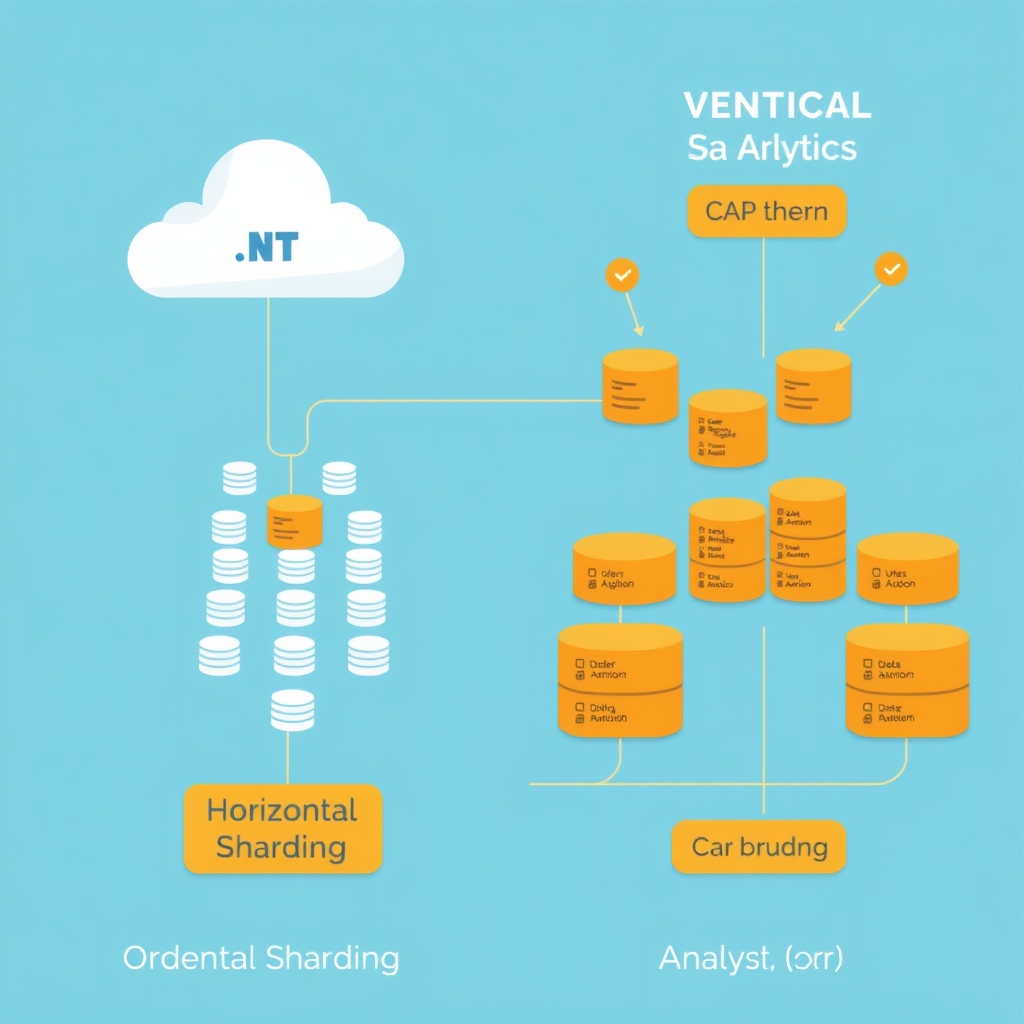
Choosing Horizontal vs Vertical Sharding in .NET Databases: A Deep‑Dive for Architects
Quick Answer
Choosing between horizontal and vertical sharding in .NET depends on write load, domain boundaries, and consistency needs. A hybrid approach often yields the best scalability and operational balance.
Quick Answer
Choosing Horizontal vs Vertical Sharding in .NET Databases: Choosing between horizontal and vertical sharding in .NET depends on write load, domain boundaries, and consistency needs. A hybrid approach often yields the best scalability and operational balance.
Row vs Function Sharding Choices
When a single SQL Server instance hits 80 % CPU or deadlock counts explode during flash‑sales, the instinct is to spin up more replicas. That’s horizontal scaling, not sharding. The real bottleneck is that all data lives in one table or schema, so every write and read contends for the same indexes, locks, and storage bandwidth. The engineering question becomes: Do we split by rows (horizontal) or by function (vertical) and how do we keep the application code sane?
Real‑World Example: A SaaS Platform Scaling from 50 k to 500 k Tenants
Our team was tasked with scaling a multi‑tenant billing system that grew from 50 k to 500 k customers in 12 months. The monolith ran on Azure SQL Managed Instance, and every tenant’s invoices, payments, and audit logs resided in a single table. Peak write traffic during end‑of‑month reconciliation hit 2 k TPS, and a single tenant’s bulk upload caused a 10‑second lock wait.
We evaluated two partitioning strategies:
- Horizontal sharding by tenant ID using a consistent hash ring.
- Vertical sharding by separating audit logs into a dedicated NoSQL store (Azure Cosmos DB) while keeping invoices in a relational database.
Both approaches required code changes, but the trade‑offs were stark.
Trade‑offs: Horizontal vs Vertical Sharding in Depth
Horizontal Sharding
Pros:
- Linear write scaling: each shard handles a fraction of the load.
- Data locality: tenant queries hit a single shard, reducing cross‑node joins.
- Operational simplicity for read‑heavy workloads: indexes can be tuned per shard.
Cons:
- Routing overhead: every request must resolve a shard key to a connection string. If the shard map is stored in a remote table, latency can balloon during peak times.
- Cross‑shard transactions are impossible without a distributed transaction coordinator, which is a performance killer.
- Rebalancing is painful: moving data between shards requires downtime or a “slow‑migration” window.
Vertical Sharding
Pros:
- Clear domain boundaries: each service owns its own database, aligning with DDD principles.
- Independent scaling: you can spin up a high‑throughput OLTP instance for orders and a separate OLAP instance for analytics.
- Security isolation: Azure AD policies can be applied per database.
Cons:
- Cross‑domain queries become application‑level choreography, adding latency and complexity.
- Schema evolution is harder: a change to a shared entity requires coordination across databases.
- Operational overhead: you now manage multiple databases, each with its own backup, patching, and monitoring.
When This Fails in Production
Even a well‑designed sharding strategy can break under real workloads:
- Hot Shard Overload: If the shard key is monotonically increasing (e.g., auto‑increment IDs), the latest shard receives the majority of writes, saturating CPU and I/O. In our billing system, tenant IDs were GUIDs, but the first 10% of GUID prefixes were heavily used by a handful of corporate customers, creating a hotspot.
- Stale Shard Map: Caching the shard map for minutes without invalidation caused requests to route to decommissioned nodes during an autoscale event, leading to connection failures and increased latency.
- Insufficient Indexing Across Shards: A global search query that spanned all tenants was executed as 500 parallel queries, each hitting its shard. Without a global index, the cost of scanning every shard was prohibitive.
Common Mistakes Engineers Make
- Choosing a shard key without validating cardinality. Many teams pick the primary key, assuming it’s unique enough, but if the key is auto‑incrementing, it introduces a write hotspot.
- Assuming the routing layer is “free.” In practice, a 1‑ms latency per request can add up to 100 ms overhead for 10 k TPS.
- Neglecting cross‑shard consistency. A naive “read‑your‑write” guarantee is impossible across shards; developers often roll their own outbox patterns without proper idempotence handling.
- Underestimating the operational cost of multiple databases. Backup, patching, and monitoring each shard can double the operational budget if not automated.
Better Approach Based on Experience
In our SaaS platform, we adopted a hybrid strategy:
- Vertical split by domain: Invoices, payments, and audit logs each live in separate databases. This aligns with our microservice boundaries and allows us to apply different scaling policies.
- Horizontal sharding within the high‑write domain (Invoices): We use a consistent hash ring on a composite key (TenantId + InvoiceId) to avoid hotspots. The shard map lives in Azure Cosmos DB (key‑value) with a 30‑second TTL and a change feed that invalidates caches on topology changes.
- Distributed transaction pattern: For critical cross‑domain operations (e.g., a payment that must be reflected in the invoice), we use an outbox pattern with a single “transaction” table per shard and a background worker that publishes events to a Kafka topic. The payment service subscribes and updates the invoice, guaranteeing eventual consistency without a distributed transaction coordinator.
- Observability: Every shard emits OpenTelemetry traces with the shard ID and domain tags. We set alerts on per‑shard latency > 200 ms and on any shard’s CPU > 70 % to trigger auto‑scaling.
This approach gave us 10× write throughput while keeping read latency under 150 ms, and the operational overhead remained manageable because we automated backup, patching, and monitoring via ARM templates.
Sharding Decision Criteria
| Criterion | Horizontal Sharding | Vertical Sharding |
|---|---|---|
| Primary Load Type | Write‑heavy, row‑level isolation (e.g., tenant data) | Mixed OLTP/OLAP workloads, clear domain boundaries |
| Consistency Requirement | Eventual across shards, strong per‑shard | Strong per‑domain, eventual cross‑domain |
| Operational Complexity | High (routing, rebalancing, shard map) | Medium (multiple DBs, cross‑domain orchestration) |
| Scaling Pattern | Linear with shard count | Per‑domain scaling, independent autoscale |
| Migration Path | Data‑heavy, requires re‑sharding logic | One‑time split, future changes via new services |
Use the table as a quick checklist. For example, if your primary goal is to scale writes for a multi‑tenant SaaS, horizontal sharding wins. If you need to isolate sensitive HR data from analytics, vertical sharding is the safer path.
Performance Considerations & Scaling Notes
- Connection Pooling: In horizontal sharding, each shard needs its own pool. Use
SqlConnectionStringBuilderto setMaxPoolSizeper shard based on expected load. - Cache the Shard Map: Use an in‑memory cache with a 30‑second TTL and a pub/sub mechanism (e.g., Azure Event Grid) to invalidate on topology changes.
- Batching Across Shards: For reporting, aggregate data in a single batch job that runs nightly. Use
SqlBulkCopyto materialize a global view in a dedicated reporting database. - Autoscaling: In Azure, tie shard count to CPU/IO metrics. A rule that adds a shard when average CPU > 70 % and removes when < 40 % keeps the system responsive.
- Observability: Instrument each shard with latency, CPU, and I/O metrics. Set an alert on
shard_latency > 200msto catch uneven key distribution early.
What is the main difference between horizontal and vertical sharding in .NET databases?
Horizontal sharding splits rows across multiple instances, usually by a shard key like tenant ID, allowing linear write scaling but requiring routing logic. Vertical sharding separates concerns by domain, placing each bounded context in its own database, simplifying domain evolution at the cost of cross‑domain orchestration.
How does a consistent hash ring help avoid write hotspots in horizontal sharding?
By hashing a composite key (TenantId + InvoiceId) to evenly distribute rows across shards, the ring ensures no single shard receives a disproportionate share of writes, even when IDs are monotonic or partially clustered.
What patterns can maintain cross‑shard consistency without a distributed transaction coordinator?
The outbox/publish‑subscribe pattern, combined with a background worker that reads the outbox and publishes events to a Kafka topic, guarantees eventual consistency between shards while keeping each shard isolated.
When should a .NET architect choose vertical sharding over horizontal sharding?
When workloads mix OLTP and OLAP, domain boundaries are clear, and strong per‑domain consistency is required; vertical sharding also simplifies security isolation via Azure AD per database.
How can the shard map be cached and invalidated efficiently in Azure?
Store the shard map in Azure Cosmos DB or a key‑value store, cache it in memory with a short TTL (e.g., 30 s), and use Azure Event Grid or a change feed to push invalidation events so the routing layer refreshes immediately after topology changes.
What to Ship
- Identify the primary access pattern for your tenant data and select a sharding key that guarantees even distribution (e.g., tenantId for row sharding or serviceId for function sharding).
- Compute the target number of shards by dividing the projected tenant count (e.g., 500k) by the maximum tenant load per shard (e.g., 5k tenants per node) and add a safety margin.
- Add a dedicated index on the chosen shard key in every table that participates in cross‑shard queries to avoid full scans.
- Implement a lightweight re‑sharding routine that can move a tenant’s data to a new shard without downtime, and test it on a 1% subset of tenants before full rollout.
- Use a sharding middleware (e.g., ShardingCore or EF Core Multi‑Tenant extensions) that automatically routes queries based on the shard key and logs shard boundaries for troubleshooting.
- Build a decision matrix that maps tenant count, query latency, and maintenance cost to a recommended sharding strategy, and review it quarterly as the tenant base grows.
Conclusion: Make the Choice That Keeps Your Code and Your Databases Healthy
Choosing between horizontal and vertical sharding isn’t a one‑size‑fits‑all decision. It’s a trade‑off between write scalability, operational complexity, and consistency guarantees. By treating sharding as a first‑class architectural decision—embedding routing logic, caching, observability, and a clear migration path—you can avoid the common pitfalls that turn a scaling effort into a maintenance nightmare.
In a production environment, the best practice is to start with a vertical split that mirrors your bounded contexts, then add horizontal sharding within the high‑write domains. This hybrid approach gives you the isolation you need for security and domain evolution, while still delivering the linear scaling required for a growing tenant base.
Related Articles
- Designing a Highly Available Vector Search Service CAP Trade‑offs for .NET
- Evaluating Azure vs AWS vs GCP for .NET Blob Storage: Latency
- Kafka producer configuration for .NET real-time streams: Tuning for Low Latency & High Throughput
- Cache-Aside vs Write-Through vs Write-Back Caching Strategies in Distributed Chat Systems
- Optimizing Latency Multi‑Agent RAG Pipelines on Azure AI Foundry: US vs India
Frequently Asked Questions
What is the main difference between horizontal and vertical sharding in .NET databases?
Horizontal sharding splits rows across multiple instances, usually by a shard key like tenant ID, allowing linear write scaling but requiring routing logic. Vertical sharding separates concerns by domain, placing each bounded context in its own database, simplifying domain evolution at the cost of cross‑domain orchestration.
How does a consistent hash ring help avoid write hotspots in horizontal sharding?
By hashing a composite key (TenantId + InvoiceId) to evenly distribute rows across shards, the ring ensures no single shard receives a disproportionate share of writes, even when IDs are monotonic or partially clustered.
What patterns can maintain cross‑shard consistency without a distributed transaction coordinator?
The outbox/publish‑subscribe pattern, combined with a background worker that reads the outbox and publishes events to a Kafka topic, guarantees eventual consistency between shards while keeping each shard isolated.
When should a .NET architect choose vertical sharding over horizontal sharding?
When workloads mix OLTP and OLAP, domain boundaries are clear, and strong per‑domain consistency is required; vertical sharding also simplifies security isolation via Azure AD per database.
How can the shard map be cached and invalidated efficiently in Azure?
Store the shard map in Azure Cosmos DB or a key‑value store, cache it in memory with a short TTL (e.g., 30 s), and use Azure Event Grid or a change feed to push invalidation events so the routing layer refreshes immediately after topology changes.